
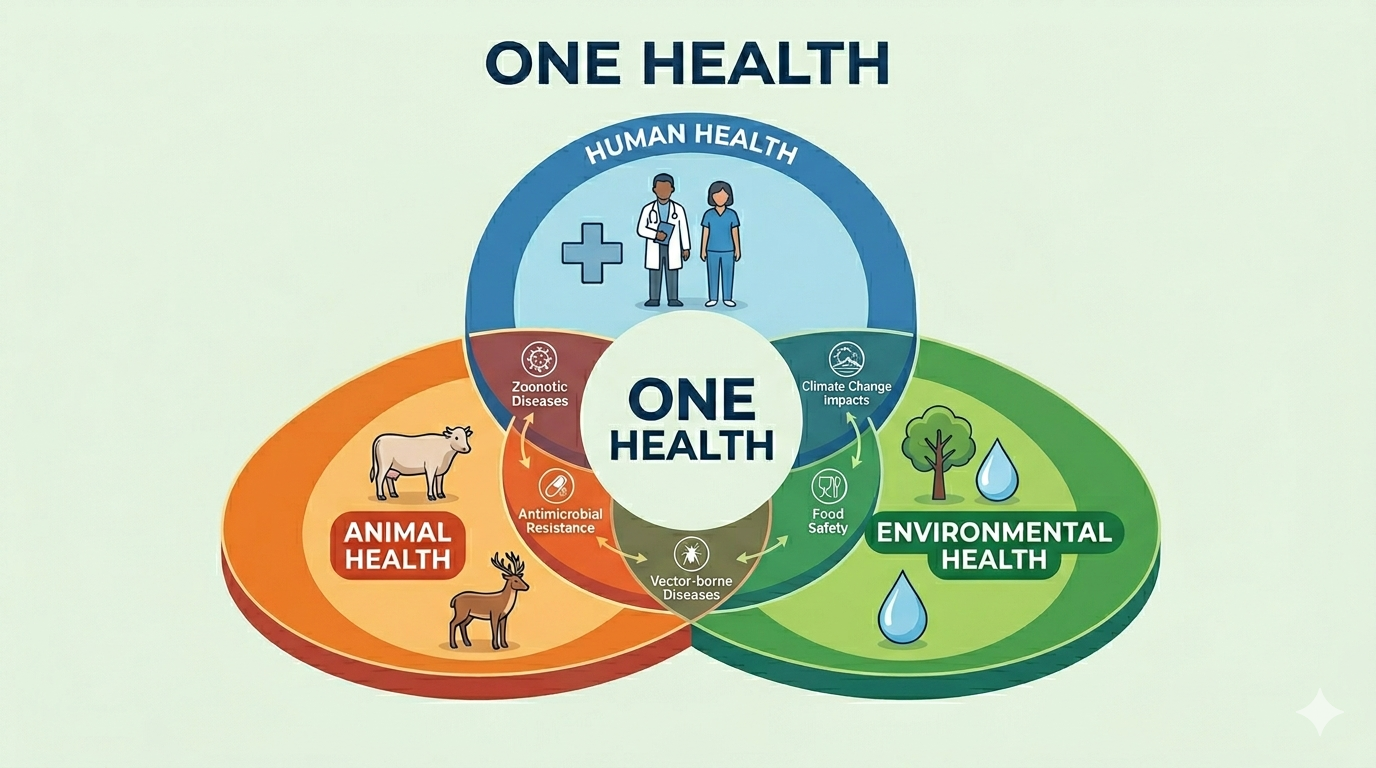
The 2003 SARS outbreak and the COVID-19 pandemic underscored that human health does not exist in isolation – it is closely connected to the health of animals and the environment around us. This is the basis of the One Health approach, which recognises that zoonotic diseases, antimicrobial resistance (AMR), food insecurity and pollution are interlinked. With around 75% of new or emerging infectious diseases (EID) in humans originating in animals and with environmental disruption increasing the risk of spillover, One Health brings together public health, veterinary science, environmental protection and policymaking. Climate change, biodiversity loss and rapid urbanisation are also increasingly being discussed in relation to global health risks. Aside from the human toll, the World Bank assesses that a comprehensive One Health prevention strategy would cost about a third of the costs of managing and responding to a pandemic.
The Quadripartite alliance among the World Health Organization (WHO), Food and Agriculture Organization (FAO), United Nations Environment Programme (UNEP), and the World Organisation for Animal Health (WOAH) developed the One Health Joint Plan of Action (2022–2026) to strengthen surveillance, preparedness and multisectoral coordination, which is supported by G20 countries, ASEAN members and various countries globally. In Southeast Asia, ASEAN has advanced regional efforts through the ASEAN Leaders’ Declaration on One Health Initiative, the ASEAN One Health Network and a Joint Plan of Action. In Europe, the approach is reflected in policy discussions on AMR, biodiversity, food systems and health emergency preparedness in their One Health overview.
This April, as we celebrate World Health Day 2026, the theme “Together for health. Stand with science” reinforces this mission. ASEF’s Public Health Network (PHN) has actively organised meetings and workshops on EID, AMR, pandemic preparedness and the environmental and social dimensions of public health. It will also be driving the momentum forward by deepening its focus on One Health, including through collaboration with the Saw Swee Hock School of Public Health at the National University of Singapore on climate change and infectious diseases.
Sources:
World Health Organization (WHO), 23 October 2023, ‘One Health’, WHO
UN Environment Programme (UNEP), March 2022 ‘UNEP One Health’, UNEP
WHO Europe, 3 November 2025, “One Health. One Planet. Our Responsibility.” WHO Europe
ASEAN, 10 May 2023, ‘ASEAN Leaders’ Declaration on One Health Initiative’, ASEAN
European Commission, ‘What is the One Health approach?, European Commission
Post Your Comments